How to Switch Health Insurance With No Waiting Period
Learn how to switch health insurance in Australia without any waiting period. Ensure your coverage continues seamlessly with these essential tips.

You can switch Australian private health insurers without re-serving waiting periods, provided you move to an equivalent or lower level of hospital cover and don't let your membership lapse. That's the law, not a marketing promise. Under the Department of Health's portability rules, your new fund must recognize the waiting periods you've already served. The catch is in the details: "equivalent cover," timing, and paperwork.
Three quick scenarios to orient you:
- Equivalent or lower hospital cover: No new waiting periods. Your served time carries over.
- Upgrading hospital cover: New waits apply only to the additional benefits you're gaining.
- Extras cover: Not legally guaranteed to carry over, but many funds honor it for equivalent extras.
Key Takeaways
Switching Australian private health insurance without re-serving waiting periods is legally guaranteed for equivalent or lower hospital cover, provided you avoid a lapse and keep your transfer certificate.
| Point | Details |
|---|---|
| Hospital portability is law | Switching to equivalent or lower hospital cover means your new fund must recognize waiting periods already served. |
| Extras portability is fund-dependent | Extras waits are not legally guaranteed to carry over; confirm in writing before switching. |
| Standard waits to know | Most services have waiting periods up to two months, while pre-existing conditions and pregnancy-related services can have longer waiting periods, up to twelve months. |
| Transfer certificate is critical | Request it from your old fund and submit it to the new fund before your start date. |
| Policyhop tracks your timing | Policyhop monitors 28 funds and alerts you when your tenure clears a fund's lookback window for a safe switch. |
Table of Contents
- Can you switch health insurance with no waiting period?
- How hospital cover portability differs from extras cover
- Standard waiting periods and when new ones apply
- How breaks in cover affect portability and lookback windows
- Step-by-step checklist to switch without re-serving waiting periods
- Exactly what to ask the new insurer before you commit
- How extras waiting periods are treated and how to keep your tenure
- Common myths, risks, and mistakes when switching
- How Policyhop helps you avoid re-serving waiting periods
- Policyhop keeps your switching timeline on track
- Sources
Can you switch health insurance with no waiting period?
The short answer is yes, for hospital cover, and it's backed by law. Under the Australian Private Health Insurance Act, if you move to a new hospital policy at the same or lower benefit level, your new insurer must recognize the waiting periods you've already served, as long as there's no significant break in cover. This is called portability, and it applies regardless of which fund you're moving to.
What counts as "equivalent"? The comparison is based on the tier of hospital cover: Basic, Bronze, Silver, or Gold. Move from Silver to Silver, or Silver to Bronze, and portability kicks in. Move from Bronze to Gold, and you'll serve new waits for the extra benefits Gold adds. Your transfer certificate, which your old fund issues when you leave, is the document that proves what you've served and triggers the recognition.
Key documents your new fund uses to confirm portability:
- Transfer certificate: Issued by your previous fund, listing your membership start date and waiting periods served.
- Policy number and membership dates: Cross-referenced against the transfer certificate.
- Product Disclosure Statement (PDS): Defines the benefit level of both your old and new policy.
How hospital cover portability differs from extras cover
Hospital portability is a legal requirement. Extras portability is not.
| Feature | Hospital Cover | Extras Cover |
|---|---|---|
| Portability guarantee | Yes, mandated by law | No legal mandate |
| Who decides | Federal legislation | Individual insurer |
| Typical fund practice | Must recognize served waits for equivalent/lower cover | Often honored for equivalent extras, but not guaranteed |
| Trigger for new waits | Upgrading to a higher tier | New benefits, higher caps, or insurer discretion |
| Evidence required | Transfer certificate | Transfer certificate plus recent claims history |
When you upgrade hospital tiers, new waiting periods apply only to the benefits you're gaining, not to everything. If you've served your 12-month wait for joint replacements under Silver and you upgrade to Gold, that 12-month wait doesn't reset. You'll only serve new waits for benefits Gold adds that Silver didn't cover.
For extras, the situation is messier. Most funds will recognize previously served extras waiting periods when you move to equivalent extras cover, but they're not legally required to. Some funds are more generous than others, and the answer often depends on whether your new extras policy matches the benefit caps and categories of your old one.
Standard waiting periods and when new ones apply
Australian law sets maximum waiting periods, and most funds apply them at or below those caps.
| Service Category | Maximum Waiting Period |
|---|---|
| Most hospital services | up to two months |
| Pre-existing conditions | up to twelve months |
| Pregnancy and birth-related services | up to twelve months |
| Psychiatric, rehabilitation, palliative care | usually up to two months for certain categories |
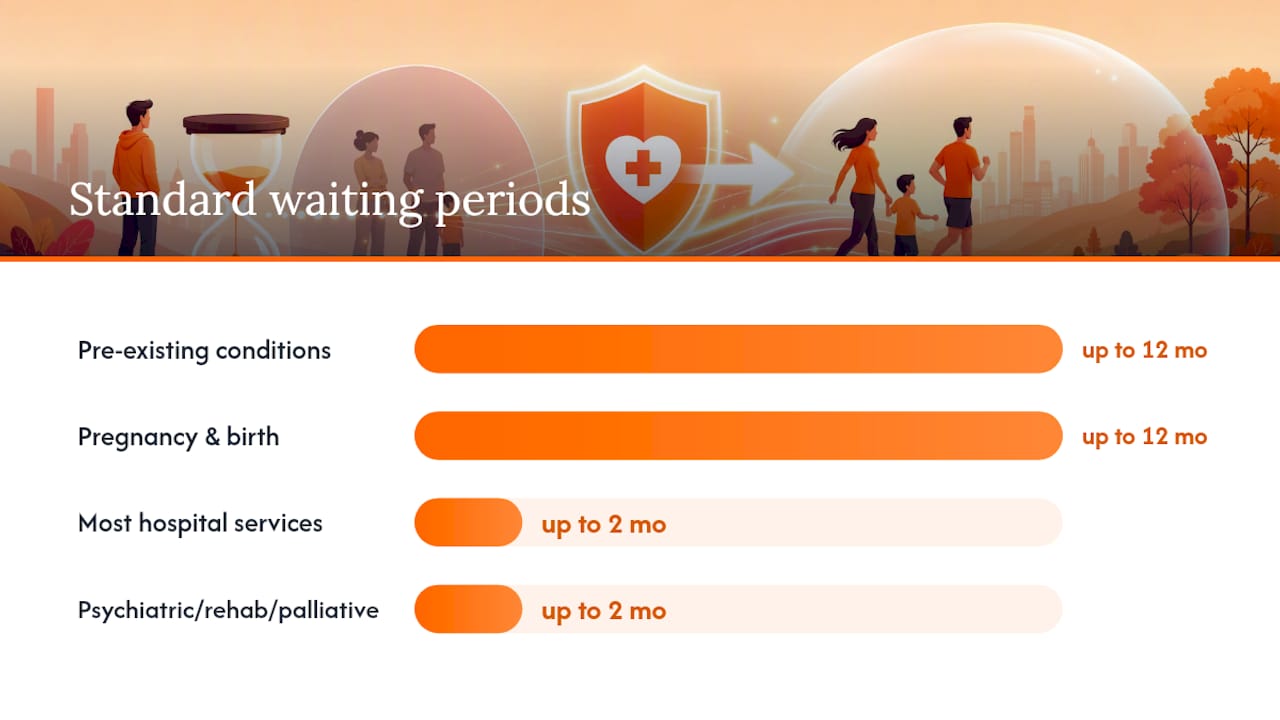
These figures come from Department of Health guidance on maximum waiting periods. Individual funds may apply shorter waits, so always check the PDS.
A few scenarios where new waiting periods kick in, even for existing members switching funds:
- Upgrading your hospital tier: New waits apply to the additional benefits only.
- Adding a new benefit category: If your old policy didn't cover a service and your new one does, you'll serve the wait for that specific benefit.
- Pre-existing conditions: If you're switching and a condition is deemed pre-existing by the new fund's assessment, a 12-month wait can apply even if you've been covered elsewhere.
- Pregnancy: If you weren't covered for pregnancy services before, a 12-month wait applies at the new fund.
Partial completion carries over. If you've served 8 months of a 12-month pre-existing condition wait, you only need to serve the remaining 4 months at your new fund, assuming equivalent cover and no lapse. For a deeper breakdown of how pre-existing condition rules work, the complete guide to waiting periods covers the assessment process in detail.
How breaks in cover affect portability and lookback windows
A lapse in cover is the single fastest way to lose portability protections. There's no single universal lookback window written into law, but most funds treat any gap in cover as a potential break that can reset your portability rights, and some will look back 30, 60, or 90 days when assessing continuity.
What typically happens with different lapse lengths:
- No gap (same-day or next-day switch): Full portability preserved. This is the safest approach.
- Short gap (a few days to 2 weeks): Many funds still recognize portability, but it's at their discretion. Get written confirmation before assuming it's fine.
- Extended gap (more than a month): Portability is at serious risk. The new fund may treat you as a new member and apply fresh waiting periods.
- Gap over 1,094 days (3 years): Lifetime Health Cover loading can apply, adding a 2% premium loading for each year you were uninsured after age 31.
The Lifetime Health Cover angle is often overlooked. A long lapse doesn't just reset waiting periods; it can permanently increase your premiums.
Step-by-step checklist to switch without re-serving waiting periods
- Check your current hospital tier. Log in to your fund's member portal or call them and confirm whether your policy is Basic, Bronze, Silver, or Gold. Write it down.
- Find a new policy at the same or lower tier. Use Privatehealth to compare policies and confirm the tier classification.
- Read the new policy's PDS. Confirm the benefit categories match or are lower than your current cover. Pay attention to any exclusions or restrictions that differ from your current policy.
- Sign up for the new policy with a future start date. Choose the day after your current policy ends as the start date.
- Request your transfer certificate from your old fund. You can do this before or immediately after canceling. The certificate lists your membership start date and the waiting periods you've served.
- Submit the transfer certificate to your new fund. Do this as soon as you receive it. Most funds process it within a few business days.
- Get written confirmation from your new fund. Ask them to confirm in writing that your previously served waiting periods are recognized and that no new waits apply for equivalent benefits.
- Cancel your old policy. Only do this after your new policy is confirmed active and you have written confirmation of portability.
Documents to have ready throughout this process:
- Your current policy number and membership start date
- Your most recent premium statement
- The PDS for both your old and new policy
- The transfer certificate once issued
For a more detailed walkthrough of the switching process, the guide on how to switch private health insurers covers timing and documentation in full.
Exactly what to ask the new insurer before you commit
Most portability disputes happen because the member assumed the fund would recognize their served waits without asking explicitly. A five-minute phone call or a short email before you sign up prevents most of these problems.
Questions to ask:
- "Does this policy match my current hospital tier of [Basic/Bronze/Silver/Gold]?"
- "Will you recognize my previously served waiting periods if I provide a transfer certificate?"
- "Are there any benefits in this policy that would trigger new waiting periods because they weren't covered under my previous policy?"
- "What's your process for accepting a transfer certificate, and how long does it take?"
Sample email script you can copy and adapt:
"Hi, I'm considering switching to [Policy Name] from [Current Fund]. My current hospital cover is [tier]. I've been a member since [date] and have served my waiting periods for [list key services]. Could you confirm in writing that: (1) this policy is equivalent to or lower than my current tier, (2) you will recognize my previously served waiting periods upon receipt of my transfer certificate, and (3) no new waiting periods will apply for the equivalent benefits? Thank you."
When the insurer responds, save the email or ask for a reference number if you called. That written confirmation is your evidence if a dispute arises later. Per AAMI's guidance on switching, funds that recognize prior waits can allow immediate claims on some services, which is exactly what you're aiming for.
How extras waiting periods are treated and how to keep your tenure
Extras cover operates differently from hospital cover, and the rules are genuinely insurer-dependent. Most funds will recognize previously served extras waiting periods when you move to equivalent extras cover, but "equivalent" here means matching benefit caps and categories, not just the same tier label.
Tips to increase the chance your extras waits are recognized:
- Match benefit caps as closely as possible. If your current extras covers $300 per year for dental, find a new policy with a similar cap.
- Provide your transfer certificate and a recent claims history statement from your old fund.
- Ask for written confirmation before switching, not after.
- Check whether the new fund has any exclusions or waiting periods for specific extras categories that your old fund didn't.
If a fund refuses to recognize your extras waiting periods:
- Ask for an internal review. Put your request in writing and include your transfer certificate and membership history.
- Escalate to the fund's complaints team. Reference the transfer certificate and any written confirmation you received during sign-up.
- Contact the Private Health Insurance Ombudsman. The Ombudsman's factsheets explain how to request your membership history and lodge a formal complaint if the fund's internal review fails.
The Ombudsman's office is free to use and has real authority to investigate disputes. Don't skip this step if you believe portability has been wrongly denied.
Common myths, risks, and mistakes when switching
Myth vs. fact:
- "Switching always resets my waiting periods." False. For equivalent or lower hospital cover, portability is legally guaranteed.
- "I need to wait until my policy anniversary to switch." False. You can switch at any time.
- "Extras portability works the same as hospital portability." False. Extras portability is fund-dependent, not legally mandated.
- "Sign-up promotions (free weeks, gift cards) mean I'm getting new cover that resets my waits." Generally false. Promotions don't change the portability rules for equivalent cover, but always confirm with the fund. The guide on sign-up offers explains how these promotions interact with continuity of cover.
Mistakes that cost people their accrued waiting periods:
- Canceling the old policy before the new one is confirmed active.
- Not requesting a transfer certificate, or requesting it too late.
- Upgrading cover without checking which new benefits trigger fresh waits.
- Assuming verbal confirmation from a call center is sufficient. Get it in writing.
- Letting cover lapse for even a few weeks without checking the fund's lookback policy.
After switching, verify you haven't accidentally triggered new waits by asking your new fund to send a written summary of your recognized waiting periods and any new ones that apply. File it with your transfer certificate.
How Policyhop helps you avoid re-serving waiting periods
The most common reason people lose their accrued waiting periods isn't a legal technicality. It's a timing or paperwork failure: a lapse nobody noticed, a transfer certificate that arrived after the new policy started, or a switch made at the wrong moment relative to a fund's lookback window.

Policyhop addresses this directly. The platform tracks your policy start date and tenure across 28 Australian health funds, monitors the lookback windows and offer eligibility of each fund, and sends you an alert when the timing is right to switch without risking your served waiting periods.
Practical scenarios where tenure tracking makes a difference:
- You've been with your current fund for 11 months. A better deal is available, but switching now means you're one month short of a fund's lookback threshold. Policyhop flags this and tells you to wait.
- A fund is running a sign-up offer that waives extras waiting periods, but it expires in two weeks. Policyhop alerts you while you still have time to act.
- You're approaching a policy anniversary that affects your no-claim bonus. The platform factors this into its switching recommendation.
You can see exactly how the tracking and alert features work at Policyhop's features page.
The part most guides skip
Most switching guides focus on the legal rule and stop there. What they underestimate is the operational gap between "portability is guaranteed" and "your new fund actually processes it correctly." The transfer certificate gets lost. The fund's system doesn't flag the served waits. A call center rep gives you wrong information and you don't have it in writing.
The legal protection is real, but it only helps you if you can prove you're entitled to it. That means the transfer certificate, the written confirmation, and the timing. Readers who treat portability as automatic and skip the documentation step are the ones who end up disputing claims six months later.
Policyhop's tenure tracking reduces that risk by keeping your policy history organized and alerting you before a lapse can occur, not after.
Policyhop keeps your switching timeline on track
Knowing the portability rules is one thing. Knowing exactly when to act, which fund's offer is live right now, and whether your tenure clears their lookback window is another. That's the gap Policyhop fills.
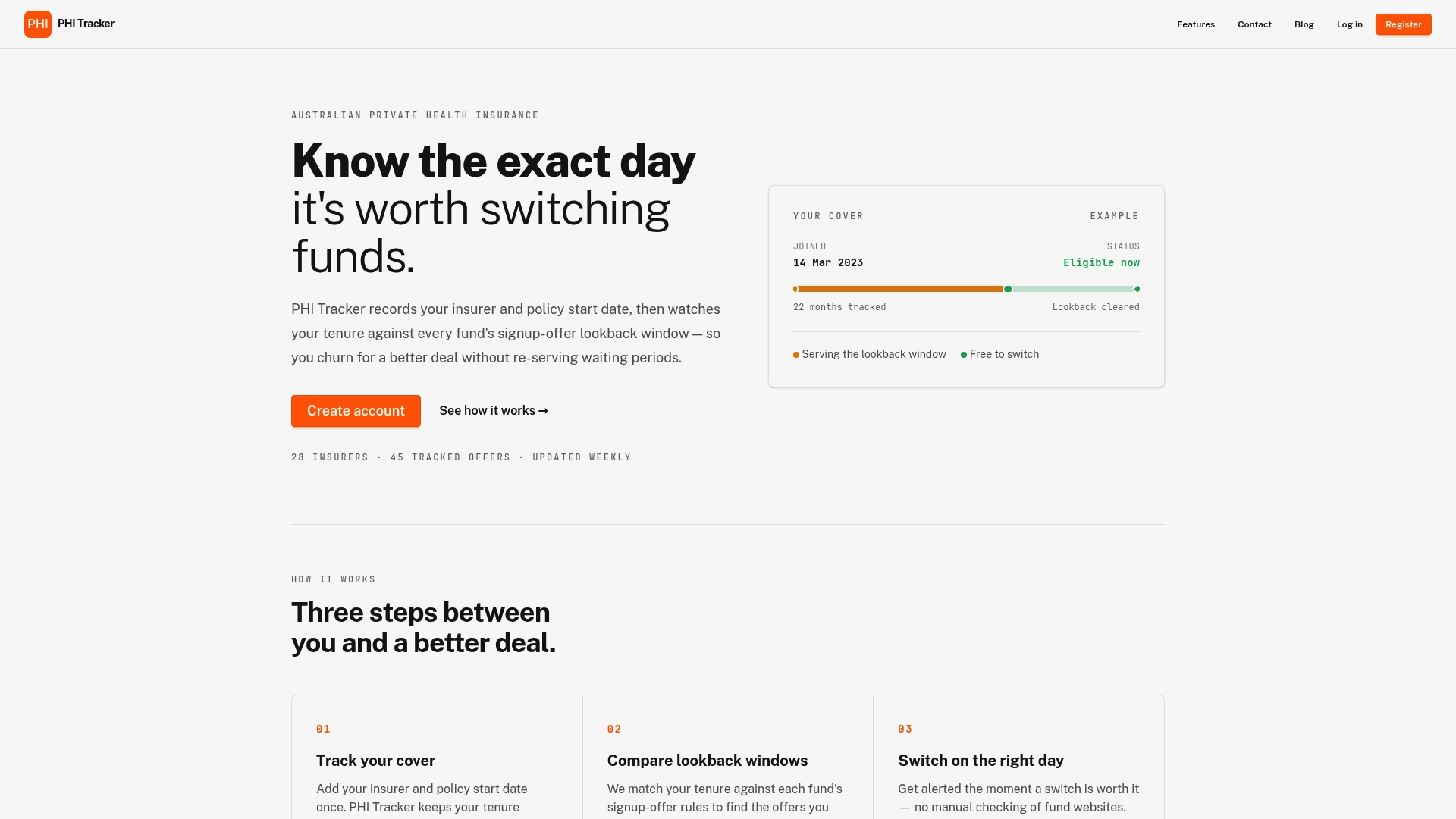
Policyhop monitors 28 Australian health funds and 45 tracked offers, updated weekly, so you're not manually checking fund websites every few months. When your tenure hits the right threshold for a better deal, you get an alert. The platform also tracks lookback windows by fund, so you can time your switch to land cleanly inside the portability window, not one day outside it. There's a free account tier to get started, and the premium subscription adds personalized alerts and full offer tracking. See what Policyhop tracks and set up your first alert today.
Sources
- Waiting periods and exemptions | Australian Government Department of Health, Disability and Ageing
- Privatehealth
- The right to change (brochure) | Office of the Australian Information Commissioner / Ombudsman
- Switch Health Insurance With No Waiting Period | AAMI
This article is general information, not a substitute for advice from a qualified financial advisor. Consult a qualified financial professional about your own circumstances before acting on anything here.
Recommended
- Private Health Insurance Waiting Periods in Australia: The Complete Guide · Health fund offer tracking
- How to Switch Private Health Insurers in Australia Without Losing Cover · Health fund offer tracking
- How health fund signup offers work in Australia · Health fund offer tracking
- Lifetime Health Cover Loading Explained · Health fund offer tracking
Ready when you are
Track your cover, switch on the right day.
PolicyHop watches your tenure against every fund's lookback window and tells you when a switch is worth it — free to start.
Create free account